Total Internal Reflection
Also, when i > C, the incident ray OA₄ reflected along A₄B₄. This phenomenon is known as total internal reflection. Hence, “The Phenomenon of bending of light in the denser medium from a denser medium when angle of incidence is greater than the critical angle is called total internal reflection”.
✶ Relation between μ & C :-
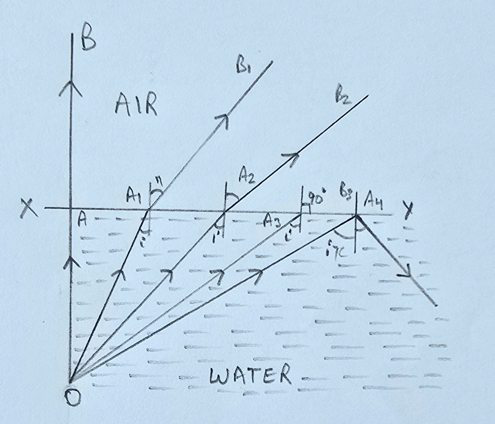
As we know that the Snell’s law is given by the relation \begin{equation} { }^b \mu_a=\frac{\sin i}{\sin r} \quad[a=\text { air }, b=\text { water }] \end{equation} –(1)
When \begin{equation} i=C, r=90^{\circ} \end{equation} , then \begin{equation} { }^b \mu_a=\frac{\sin C}{\sin 90^{\circ}}=\sin C \end{equation} –(2)
But as we know that \begin{equation} { }^b \mu_a=\frac{1}{a_{\mu_b}}, \end{equation} Hence eqⁿ(2) becomes \begin{equation} \frac{1}{a_{\mu_b}}=\sin C \Rightarrow{ }^a \mu_b=\frac{1}{\sin C}=\frac{\mu_b}{\mu_a} \end{equation}
* Essential Conditions for Total Internal Reflection →
- Light should travel from a denser medium to rarer medium.
- Angle of incidence in denser medium should be greater than the critical angle for the pair of media in contact (i > C)
________________________________________________________________________________________________________
* Applications of Total Internal Reflection →
MIRAGE → “Mirage is an optical illusion, generally observed in deserts, in which the high objects (such as trees) appears to be inverted giving the impression of reflection from the pond of water”.
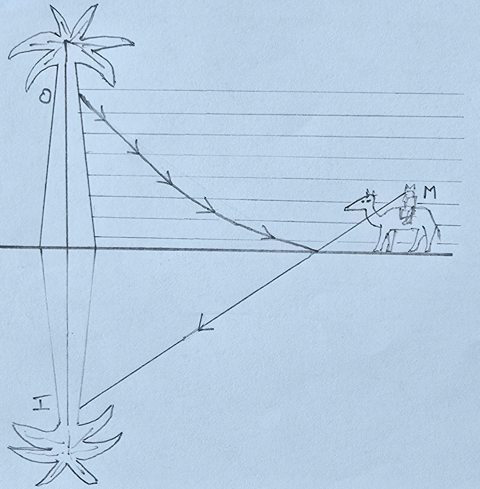
Explanation → The phenomenon of mirage is due to total internal reflection. In the desert, due to rise in temperature of earth’s surface, the atmosphere air gets splited into layers of different temperatures. The temperature decreases of the tree (O) bends away from the normal on reflection at each layer. As a result, the angle of incidence on the layer goes on increasing, till the angle of incidence is more than the critical angle (i > C). This produces an inverted image of the tree, which gives the impression of reflection from the surface of water.
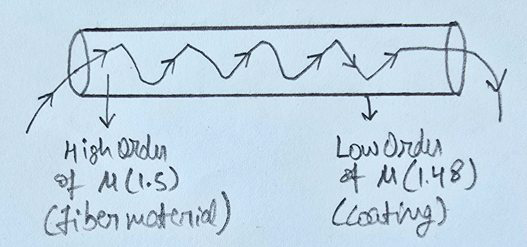
2) Optical fibers → There are also based upon the phenomenon of total internal reflection. The optical fiber consists of several thousand of very-long fine quality fibers of glass or quartz. The diameter of each fiber is about 10⁻⁴ cm, with refractive index of the material is of the order of 1.5. The fibers are coated with a thin layer of material of lower refractive index of the order of 1.48.
Light incident on one end of the fiber at small angle passes inside & undergoes reflected total internal reflections inside the fiber. It finally comes out of the other end. There is almost no loss of light through the sides of the fiber. The only condition is that i > C for the fiber material w.r.t. its coating.
Uses:
- They are used in the field of communications, computers, transmitting & receiving signals, cable system etc.
- The optical fiber sensors have been used to measure temp. & pressure.
- They are used to transmit light without any loss in the intensity over long distances.
* Spherical Refracting Surfaces → The portion of the refracting medium, whose curved surface forms the part of a sphere, is called spherical refracting surface. They are of two types,
a) Convex spherical refracting surface → A surface which is convex towards the rarer medium side is called convex spherical refracting surface (fig – 1)
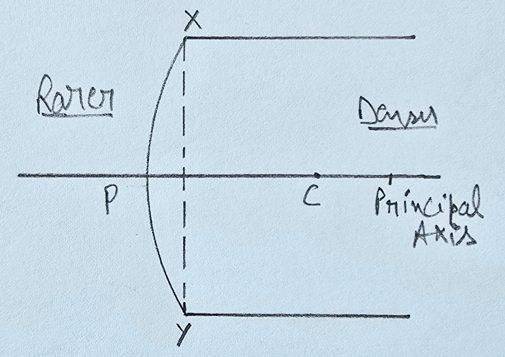
b) Concave spherical refracting surface → A surface which is concave towards the rarer medium is called concave spherical refracting surface (fig – 2)
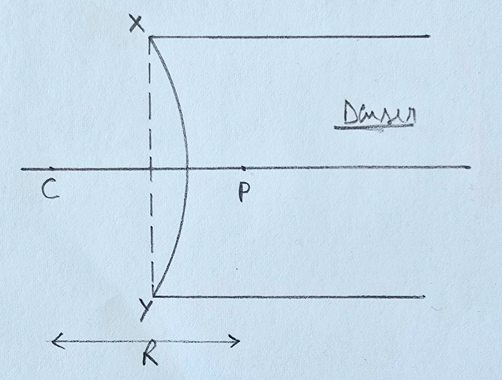
* Various Terms Used →
i) Pole / Vertex → The center of a spherical refracting surface (mirror’s reflecting surface) is called its Pole.
ii) Centre & Radius of Curvature → The center of the sphere of which the curved surface forms a part is called its Centre of Curvature (C) & the radius of the sphere of the curved surface (PC = R) is called its Radius of Curvature.
iii) Aperture → The diameter of the spherical refracting surface is called its aperture. The line joining the points X & Y represents the aperture of the spherical refracting surface.
iv) Principal axis → The line passing through the pole & center of curvature of the spherical refracting surface is called its Principal Axis.
v) Principal Focus → It is that point on the principal axis at which all the incident rays, after reflecting (or refracting) from a surface meet or appear to diverge after reflection from the mirror.
vi) Focal Length → The distance between the principal focus & the pole of the spherical surface is called its focal length.