Lab Work: Refractive Index of Glass
Equipment:
● Ray box and single slit grating to create a narrow beam
● Glass block
● Paper
● Pen/pencil
● Ruler
● Protractor
Method:
1. Set up the experiment in a darkened room.
2. Place the glass block on the paper and draw around it to ensure that the block will always be in the same place even if you remove it and replace it.
3. Using the protractor, draw a line that is 90º to the surface of the glass block (this is the ‘normal’).
○ It may be easier to move the block and work from the outline on the paper for this part since you need to continue the line into the glass block outline.
4. Draw three lines as guides for the angles you are going to direct the light into the block.
○ These will hit the block at the point where you drew the normal.
○ Example angles are 20º, 40º and 60º.
5. Direct the light along each of these lines in turn and, for each one, make markings where the light leaves the block on the other side.
○ This can be done by drawing dots or Xs and joining them together with a ruler once you have moved the block out of the way.
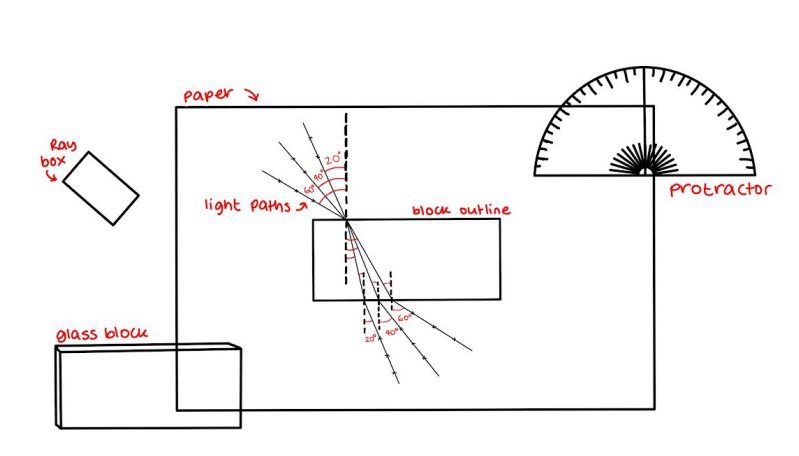
6. Connect the point of incidence to the point where the light leaves the block for each angle, which should leave you with something like the diagram below.
○ Ensure that there is a normal line (90º to the surface of the glass as before) at each point where the light leaves the block.
7. Use the protractor to measure all the angles of incidence and refraction and mark these on the paper.
○ The angle of incidence where the light initially hits the block should be equal to, or very close to, the angle where the light is leaving the block.
○ Always measure angles from the normal to the path of the light.
8. The refractive index of glass when light enters from air is given by \begin{equation} n=\frac{\sin (i)}{\sin (r)} \end{equation} , where ‘i’ is the angle of incidence and ‘r’ is the angle of refraction
9. Use the angles you measure to calculate the refractive index of the glass block.
○ If the values vary, take the average.
Diagram:
Safety Precautions:
● Do not touch the ray box when it is in use or just after it has been used – it heats up and could cause burns if handled, before it has cooled down.
● Take care in a darkened room – there may be trip hazards that are less visible when the lights are dimmed.