Uniformly Accelerated Motion
It is defined as the time rate of change of velocity of an object. Mathematically
\begin{equation}
\text { Acceleration }=\frac{\text { change in velocity }}{\text { time taken }}
\end{equation}
(It is measured in m/s²)
Retardation:
The negative acceleration is known as Retardation or deceleration.
Uniform Acceleration:
An object is said to be moving with uniform acceleration if it undergoes equal velocity in equal interval of time.
Non–Uniform (Variable) acceleration:
An object is said to be moving with variable acceleration if it undergoes unequal velocity in unequal intervals of time & vice versa.
Average Acceleration
\begin{equation}
\text { Average Acceleration }=\frac{\text { Total change in velocity }}{\text { Total time taken }}
\end{equation}
Instantaneous Acceleration
Acceleration of an object at any instant of time is instantaneous acceleration.
“Equations of motion”
Method – A)
By General Method of uniformly accelerated motion along a straight path (In one dimension)
a) Velocity–Time Relation (v = u + at)
Let us consider an object moving with uniform acceleration along a straight path OX.
Let t1,v1 be the time & velocity of the object at A and t2,v2 be the time & velocity of the object at B. Let x1,x2 be the position of the object at time t1 & t2 respectively.
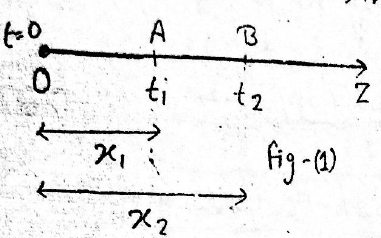
As we know that Acceleration = change in velocity / time taken
\begin{equation}
\begin{aligned}
&a=\frac{v_2-v_1}{t_2-t_1}\\
&\Rightarrow\left[v_2-v_1=a\left(t_2-t_1\right)\right]
\end{aligned}
\end{equation}
⇒ 1)
If u= initial velocity of the object at t=0 (i.e. t1=0,v1=u) & v= final velocity at time t=t2(i.e. t2=t,v2=v)
Then equation (1) becomes:
v – u = at OR v = u + at
b) Position–Time Relation (s = ut + 1/2 at²) If be the average velocity of the object from A to B, then we have:
$$
V_{a v}=\frac{\text { displacement }}{\text { time }}=\frac{x_2-x_1}{t_2-t_1}
$$
or
$$
x_2-x_1=V_{a v}\left(t_2-t_1\right)
$$
or
$$
\begin{aligned}
& x_2-x_1=\frac{v_1+v_2}{2}\left(t_2-t_1\right)- \\
& {\left[v_1=\text { Initial velocity }\right]}
\end{aligned}
$$
If u=initial velocity of the object at t = 0 , final velocity of the object at any time t,
x0 = initial position of the object A, & x = final position of the object B,
then eqn (1) becomes:
\begin{equation}
\begin{aligned}
& x-x_0=\frac{u+v}{2}(t) \\
& x-x_0=\frac{1}{2}(u+v) t
\end{aligned}
\end{equation}
As we know that v = u + at, with that above eqn becomes…
x – x₀ = ½ [u t + (u + at).t ]
or x – x₀ = ½ [u t + u t + at² ] = ½ [2u t + at²]
or x – x₀ = 2ut/2 + at²/2 ⇒ x – x₀ = ut + ½ at² (2)
As x – x2 = change in the position of the object, known as displacement (S). Hence (2) becomes
\begin{equation}
S=u t+\frac{1}{2} a t^2
\end{equation} (3)
c) Position–velocity Relation (v² – u² = 2aS) :→
From velocity–time relation, we know that v₂ = u + at
or v₂ – u = at
or t = (v₂ – u)/a (1)
Also from position–time relation, we know that S = ut + ½ a t² (2)
Putting the value of t (1) in eq (2), we have
S = u (v₂ – u)/a + ½ a ( (v₂ – u)/a )²
S = u(v₂ – u)/a + ½ a ( v₂² + u² – 2u v₂ )/a²
S = (uv₂ – u²)/a + ½ (v₂² – u² – 2uv₂)/a
S = (uv₂ – u² + ½ v₂² – ½ u² – uv₂)/a
S = (v₂² – u²)/2a
\begin{equation}
v^2-u^2=2 a S
\end{equation} (3)
Also, distance travelled by the object in time ‘t’ is
S = area of trapezium OABE
= area of rectangle OADE + Area of triangle ADB
= OA × OE + ½ DB × AD
= ut + ½ at × t [ :: DB = at ] by using eqⁿ (1)
⇒ \begin{equation}
S=u t+\frac{1}{2} a t^2
\end{equation}
d) Velocity–Displacement (Position–velocity) Relation :→
As we know that, the displacement (S) = Area of trapezium OABE i.e. S = ½ (EB + OA) × OE
= ½ (EB + ED) × OE [:: OA = ED] (1)
Also, the acceleration
$$
a=\text { slope of v-t graph i.e. } a=\frac{D B}{A D}=\frac{E B-E D}{O E}
$$
or
$$
O E=\frac{E B-E D}{a}
$$
By using eqn (2) in (1), we have
$$
S=1 / 2(E B+E D) \times(E B-E D) / a=1 / 2 a\left(E B^2-E D^2\right)
$$
or
$$
S=\frac{1}{2 a}\left(v^2-u^2\right)
$$
$$
v^2-u^2=2 a S
$$