Projectile Motion
The path followed by a projectile is called its trajectory.
e.g. A bullet fired from a gun, A piece of stone thrown in any direction.
“Motion of a Projectile”
A) Projectile given Horizontal Projection :-
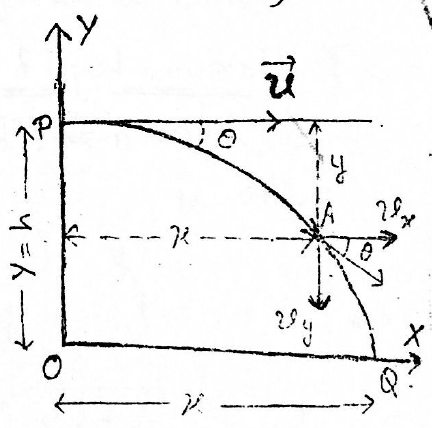
Theory :- Let us consider a projectile, which is thrown horizontally with an initial velocity from the top of the tower of height ‘h’. As it moves it covers the horizontal distance due to uniform horizontal velocity (u) & then moves vertically downward due to constant acceleration due to gravity. Hence time taken by the projectile to reach the ground at Q & the horizontal & vertical distance travelled by the projectile.
Projectly or Motion along Horizontal direction →
The motion of a projectile is in plane & the equation describing the motion is given by (along x–axis)
\begin{equation}
X-X_0=U t+\frac{1}{2} g_x t^2
\end{equation} -(1) [ :: S = Ut + ½ a t² ]
Hence Uₓ = U & aₓ = 0, X₀ = 0 [:: velocity along horizontal path is constant, hence a = 0]
Substitute these values in eqⁿ (1), we have
\begin{equation}
X=U t \quad \text { or } \quad t=X / U
\end{equation} -(2)
2) Trajectory along vertical (Y) direction :→
Here, the equation of motion is
\begin{equation}
Y-Y_0=U_y t+\frac{1}{2} a_y t^2
\end{equation}
Here y = 0 Uy =0 & ay = g (acc. due to gravity) [there is no initial vel. along y–axis]
\begin{equation}
Y=\frac{1}{2} g t^2
\end{equation} -(3)
Also As \begin{equation}
t=\frac{X}{U}
\end{equation} Using this in equation (3) we have,
\begin{equation}
\begin{aligned}
& Y=\frac{1}{2} g\left(\frac{X^2}{U^2}\right) \\
& Y=\frac{1}{2} k X^2\left[k=\frac{g}{U^2}\right] \quad \text { (4) }
\end{aligned}
\end{equation}
Which is the equation of parabola (↓)
3) Maximum height & Time of Flight :→ Let ‘h’ be the height of a tower along the vertical direction. Then equation of motion is
$$
\begin{aligned}
& Y-Y_0=U_y t+\frac{1}{2} a_y t^2(\text { along vertical }) \\
& Y=\frac{1}{2} g t^2
\end{aligned}
$$
As Y=h, above equation becomes
$$
h=\frac{1}{2} g t^2
$$
From eqⁿ (5), we have the total time of flight (t = T) is
$$
h=\frac{1}{2} g T^2 \Rightarrow T^2=\frac{2 h}{g} \text { or } T=\sqrt{\frac{2 h}{g}}
$$
Hence Time of Flight (T) is the total time taken by the projectile to complete its trajectory.
4) Horizontal Range :→
It is the horizontal distance travelled by the projectile during its flight.
(In this case, the equation…) of motion is
$$
X-X_0=U x t+\frac{1}{2} a_x t^2
$$
\begin{equation}
\text { Here } X=R \text { (Horizontal Range), } U_x=U \quad \& \quad a_x=0 \text {. Hence }
\end{equation}
\begin{equation}
R=U T \text { when } \mathrm{T}=\text { total time of flight }
\end{equation} (7)
\begin{equation}
\text { As we know that } T=\sqrt{\frac{2 h}{g}} \text {, with that equation (7) becomes }
\end{equation}
$$
R=U \sqrt{\frac{2 h}{g}}
$$
5) Resultant velocity →
a) Horizontal velocity →
Let at any instant of time, the projectile be at point A (refer figure).
As we know that, along x–axis, velocity (vₓ) is
\begin{equation}
\begin{array}{ccc}
& v_x=U_x+a_x t & \left(U_x=u\right) \\
\text { Here } U_x=U, a_x=0 . & v_x=U &
\end{array}
\end{equation}
b) Vertical velocity →
\begin{equation}
\begin{aligned}
&v_y=U_y+a_y t\\
&\text { Here } U_y=0 \quad \& \quad a_y=g \Rightarrow \quad v_y=g t
\end{aligned}
\end{equation}
Now, resultant velocity of the particle at time ‘t’ is given by
$$
\begin{aligned}
& v=\sqrt{v_x^2+v_y^2+2 v_x v_y \cos \theta} \\
& v=\sqrt{v_x^2+v_y^2}
\end{aligned}
$$
\begin{equation}
\text { Here } \theta=90^{\circ}
\end{equation}
Using (9) & (10), equation (11) becomes
$$
v=\sqrt{U^2+g^2 t^2}
$$
Also, as we know that \begin{equation}
t=\sqrt{\frac{2 h}{g}}
\end{equation} Putting this value in equation (12), we have “velocity of projectile when it hits the ground”
\begin{equation}
\begin{aligned}
v & =\sqrt{U^2+g^2\left(\frac{2 h}{g}\right)} \\
v=\sqrt{U^2+2 g h} & \text { (13) }
\end{aligned}
\end{equation}
B) Projectile given Angular Projection : This type of Rejection can be projected in two ways; This Projection is also called Oblique Projection can be explained
(B) Projectile fired at an angle with the horizontal
(oblique Projection)

Theory → Let a projectile be thrown with initial velocity u at an angle O with the horizontal direction. Then the velocity u is resolved into two rectangular components:
1. $u \cos \theta$ along OX (horizontal)
2. $u \sin \theta$ along OY (vertical)
Let us suppose that the object reaches at point ‘P’ after any time. Then
x = horizontal distance travelled by the object y = vertical ‘ ’
1) Trajectory or Motion Along Horizontal Direction → For horizontal motion we have the equation of motion is
\begin{equation}
\begin{aligned}
&X-X_0=U_x t+\frac{1}{2} a_x t^2\\
&\text { Here } U_x=u \cos \theta, X_0=0, a_x=0 \text {. Hence above eq } \mathrm{q}^{\mathrm{n}} \text { becomes }\\
&x=\frac{u \cos \theta \cdot x}{u \cos \theta} \quad t=\frac{x}{u \cos \theta}
\end{aligned}
\end{equation}
2) Trajectory Along Vertical Direction →
In this case, the equation of motion is
$$
Y-Y_0=U_y t+\frac{1}{2} a_y t^2
$$
Here
$$
U_y=u \sin \theta
$$
\begin{equation}
a_y=-g, \quad Y_0=0 \quad[\text { for upward motion } \mathrm{a}=-\mathrm{g}]
\end{equation}
$$
Y=u \sin \theta \cdot t-\frac{1}{2} g t^2
$$
Also, putting the value of
$$
t=\frac{x}{u \cos \theta}
$$
in equation (2), we have
$$
\begin{aligned}
& Y=\frac{u \sin \theta \cdot x}{u \cos \theta}-\frac{1}{2} g \frac{x^2}{u^2 \cos ^2 \theta} \\
& Y=x \tan \theta-\frac{g}{2 u^2 \cos ^2 \theta} x^2
\end{aligned}
$$