Thomson’s Atom Model
Limitation of Thomson atom Model
- It could not explain the x-ray scattering experiment as observed by Rutherford.
- It could not explain the origin of spectral series of H-atom.

Rutherford’s X-Ray Scattering Experiment (Introduction of Nucleus)
Introduction – An x-particle is a helium nucleus Containing 2 protons & 2 neutrons. Thus, its charge is +2e & mass is nearly four times the mass of a proton. It is denoted by He2+.
Experimental Set up – The experimental Set up used by Rutherford is shown in the figure. According to that experiment, when ‘’ bear of suitable frequency from a lead cavity (source of particle) after passing through collimator (it makes the beam fine & parallel) falls on a thin gold foil, the -particles scattered in different directions are observed through a rotatable detector Consisting of a zinc sulphide screen (ZnS screen) & a microscope. After passing through gold foil, the x-particle deviates through some angle from it original direction. That angle is known as angle of scattering (theta)
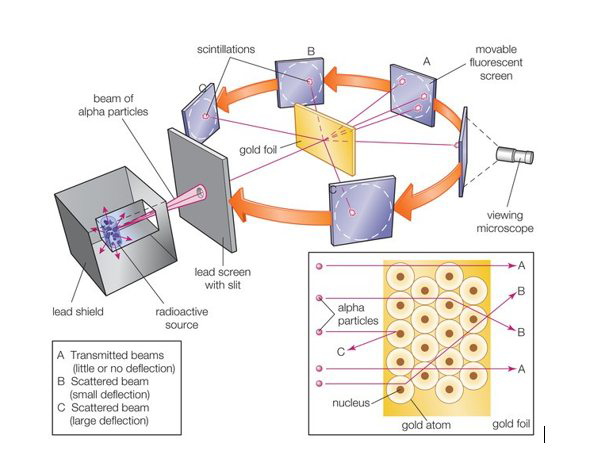
Observation from the experiment – from the experimental study, we can observe that
- Most of the alpha-particles passes straight without any deviation. It means they do not suffer collision with global atoms.
- Only some of the alpha-particle scattered through large angle (theta 79°), by experiencing a strong repulsive force.
- Almost as rarely (one alpha-particle Cone in 8000 alpha-particles) retraces its fate, scattering throng 180.
If we plot a graph between the different scattering angles (theta) with the no. of alpha-particles scattered, we have the graph as shown in the figure.
From the graph, we can conclude that, larges the angle of a scattering, smaller will the no. of alpha-particles scattered & vice versa.
From the above observation, one can say that “the entire positive charge of the atom must be concentrated in a tiny central core of the atom. This tiny central core of each atom is called atomic nucleus”.
Postulates of Rutherford Atom Model
- Every atom consists a tiny central core, called atomic nucleus, in which entire positive charge & almost entire mass of the atom are-concentrated.
- The size of the nucleus is of the order of 10-15 m which is very small as comparison to the size of the atom.
- The atomic nucleus is surrounded by a certain no. of electrons. The no. of revolving elections is equal to the no. of positive charge in the nucleus. Hence atom is electrically neutral.
- The centripetal force required by the elections for revolution is provided by the electrostatic force of attraction between the elections & the nucleus.
Nucleus fission – It is the phenomenon of splitting of a heavy nucleus into two or more lighter nucleus.
For example, when 92U235 is bombarded with thermal neutrons, it splite into 56Ba141 & 36Kr92 with the emission of 3 neutrons along with 200 Mev of energy per fission i.e.
92U235 + 0n1 -> 56Ba141 + 36Kr92 + 3 an1 + Theta
Nucleus fusion – A process in which two or more lighter nuclear combine to form a heavy nucleus, is known as nucleus fusion.
some of the examples of nucleus fusion are :-
1H1 + 1H1 1H2 + +1e0 + 0.42 Mev
1H2 + 1H2 2he3 + 0n1 + 3.27 Mev
1) Nuclear Holocaust – The radioactive waste or dust hanging like clouds in the sky or atmosphere of earth due to heavy use of nuclear weapons etc. is called Nucleus Holocaust This can destroy every type of life on earth & will not allow life to occur again. The nucleus clouds will not allow sunlight to reach the earth causing nucleus winter. This type of uncontrolled release of energy due to atomic explosion may be controlled to avoid this state.
Nuclear Binding Energy – As we know that Nucleus in every nucleus are bound together with short range interacting forces, called Nuclear forces. A definite amount of work has to be done to separate the nucleus from the nucleus to such a distance that there is no interaction between them. This work done is a measure of Binding energy of the nucleus.
Also, “The energy with which the nucleus bound within the nucleus is also referred as Binding energy.”
According to Einstein theory, it is found that “the masses of the neutron & proton is somewhat greater than the mass of the nucleus”. This difference between the sum of the masses of nucleus (neutrons & Protons) & the mass of the nucleus is called the mass defect (m). This mass defect appears in the form of energy (E=MC²) i.e bonding energy, which is responsible for binding the nucleus within the nucleus.
Expression for Nuclear Binding Energy – According to the definition of mass defect, we know that the mass defect is equal to the difference in the masses of nucleus [mass of Proton & mass of neutrons ] & the mass of the nucleus (). Mathematically.
\begin{equation}
\Delta m=\left[Z M_p+(A-Z) M_n-M_N\right]
\end{equation} – (1)
on adding & subtracting in the above eqn, we have
\begin{equation}
\begin{aligned}
& \Delta m=\left[Z M_p+Z m_e+(A-Z) M_n-Z m_e-M_N\right] \\
& \text { OR } \Delta m=\left[Z\left(m_p+m_e\right)+(A-Z) M_n-\left(Z M_e+m_N\right)\right]
\end{aligned}
\end{equation} – (2)
If ‘m’ is the mass of the atom ZXA, then we can write
\begin{equation}
m\left({ }_Z X^A\right)=m_N\left({ }_Z X^A\right)+Z m e-\frac{B \cdot E}{C^2}\left[\begin{array}{cc}
E= & m c^2 \\
m= & E / C^2
\end{array}\right]
\end{equation}
Experimentally, the value of for electron is very-very small & can be neglected.
with that above eqn becomes
\begin{equation}
m\left({ }_Z X^A\right)=m_N\left({ }_Z X^A\right)+Z m e
\end{equation} – (3)
and for H-atom, the above eqn (3) can be written as
\begin{equation}
\begin{aligned}
&m_H=m_p+m_e\\
&M_N=m_n+m_p \& \text { for }\\
&\text { H-atom, } m_n=0\\
&=m_N=m_p
\end{aligned}
\end{equation} – (4)
using eqn (3) & (4) in eqn –(2), we have
\begin{equation}
\Delta m=\left[Z m_H+(A-Z) m_n-m\left({ }_Z X^A\right)\right]
\end{equation} – (5)
using Einstein mass-energy equivalence, we have
\begin{equation}
\begin{gathered}
E=\Delta m c^2 \\
E=\left[Z m_H+(A-Z) m_n-m\left({ }_Z X^A\right) C^2\right]
\end{gathered}
\end{equation} – (6)
which is the required expression for nucleus Binding energy.
Binding Energy Curve (Av. Binding energy per nuclear)
It is graphical relation between the Binding energy for nucleon heat from the core of the nucleus reactor to the surroundings to water in a heat exchanges. As a result of it, steam in produced at a very high pressure which driver a turbine attached with an electric generator. Commonly used contests are water, Co₂ & nitrogen etc.
Shielding – The while reactor is protected with concrete walls (=2 h 2.5 mythical), so that radiations emitted during nucleus reactions may not produce harmful effects to the surrounding.
Working – At we know that the fissionable material used in the reactor is called the fuel of the reactor. For this let a few uranium no tape 92U235 undergo fission liberating fast neutrons. These fast neutrons are slowed down by the moderator. To control the chain reaction from becoming violent, rods of bacon or cadmium are immersed in the holes of a reactor core, of to desirable length. As a result of there, the derived no. of neutrons are absorbed & only limited no. of neutrons are left to produce fission.
Also, during Fission process, heat is produced in the nuclear reactor. The coolant transfer this heat form the nucleus reactor to the water in heat exchanger. Due to that, a steam is produced which driver a turbine attached with the generators. This whole process repeat & we get Continuous supply of energy in the form of electricity. Thus, we have a controlled chain reaction & hence the energy produced can be used for constructive purposes.